Showing posts with label art. Show all posts

Sunday, May 23, 2021

On Gravity Glue

The importance of equilibrium


Michael Grab is an artist with a website called Gravity Glue. I think its a great title, which describes perfectly his stone balancing art work. It’s also a really good description for the concept of equilibrium, which is probably the most important principle in structural engineering. For unless there is equilibrium none of the other concepts much matter.

If you have not come across stone balancing before it is worth looking at Gravity Glue. The essential idea is to stack a pile of rocks one on top of the other without them toppling. The key is to find stones of different shapes and sizes and to join them in a way that intuitively seems unstable. There is nothing holding the stack of rocks together other than gravity acting on their weight and pushing them together; hence the term gravity glue. Finding precisely the right position and angle to stack each rock is tricky. It takes experience and patience to find the point of balance.


I don’t just like Michael Grab’s stone balancing, because of the engineering parallel, but also because the arrangements he creates are attractive in their own right. Some of this is attributable to the visual backdrops, but it is also more than that. His arrangements are clever and visually interesting. I too could balance some rocks on top of each other, but I don’t think the result would come close to what Grab achieves. He manages to surprise our innate sense of balance and to challenge our perception of what ought to be stable. I think it is these qualities, which provide the visual interest.

Equilibrium is simply the term that engineers use to describe a structure that is balanced. In order for balance to be achieved two criteria must be satisfied. Firstly, the magnitude and direction of all the forces acting on and within the structure must add up to zero i.e. for every force acting upwards there must be one of equal magnitude acting downwards. Similarly, for every force acting left there must be one of equal magnitude acting right. If this condition is not satisfied the structure will not be stable and will move in the direction of the unbalanced force. For example, if the force acting to the left is greater than that acting to the right then the structure will move to the left.

The second condition of equilibrium is that the moments resulting from the forces acting on a structure must also add up to zero. Moment is a turning action, which is the product of a force and its distance from the point of rotation. For this reason a small force acting at a large distance can generate the same moment, as a large force acting at a short distance. This abstract concept is easily illustrated by considering an adult and a child on a see-saw. To find the point of balance the adult must move closer to the fulcrum of the see-saw than the child. Conversely, if the adult sits too close to the end of the see-saw the child will be propelled upwards and the adult downwards. It follows that if the forces acting on a structure are balanced, but the moments are not, then the structure will topple in the direction of the unbalanced moment.

Applying these principles to stone balancing the forces acting on a stack of rocks are the self weights of the stones due to gravity. The first of the two equilibrium conditions is satisfied  by default. Since the stack is supported on the ground the ground will push back on the stones with an equal an opposite force. If it did not then the rocks would either sink into the ground or they would take off. The tricky bit is therefore balancing the moments.


Since the rocks are of different sizes and have unusual shapes their centre of gravity [the axis through which their weight acts] does not act through the point where the rock above is in contact with the rock below. An overturning moment is therefore generated. To balance the overturning moment the rock above must be rotated to move its centre of gravity towards the point of contact or the next rock up must be placed such that it generates a restoring moment in the other direction. As long as one of these two options are selected then the stack will be in equilibrium and will remain stable.

That said, if the weather were to turn and a strong wind were to blow then an additional external overturning moment would be generated. If this moment exceeds the effect of the stones self weight then the stones will topple. This thought introduces an interesting subtlety to the concept of equilibrium.

A structure can be in a state of equilibrium, however if that equilibrium is vulnerable to disturbance by an external action, particularly a small disturbance, then it is said to be in a state of unstable equilibrium. This is precisely the reason why stone balancing is difficult and requires such patience. The arrangements are invariably in a state of unstable equilibrium and in many cases the stability of the lower stones relies on the presence of the upper stones. I imagine that it must require octopus-like qualities to hold the lower stones in precisely the right place while the upper ones are added.

It is precisely this unstable form of equilibrium, which makes Michael Grab’s creations so visually interesting. Much like trying to stand a pencil on its end it does not seem possible to find the ‘Goldilocks point’ were there is neither too much over-turning moment in one direction nor in the other. Herein lies the patients and the skill.


Of course, while it creates an interesting work of art, unstable equilibrium is not at all desirable in buildings and bridges. It is self-evident that you want such structures to be resilient to disturbance so that they do not easily become unstable. Indeed this is a key structural design principle.

This does not stop an engineer from appreciating Michael Grab’s gravity glue. I would suggest it enhances your appreciation of his art.


Sunday, April 4, 2021

On Canaletto & Bridges

Tangent & Radial Trussing


The eighteenth century painter Canaletto was well known for his Venetian paintings, many of which were commissioned by British Patrons. This gave him a reason to move to the UK when war broke out.

One of his commissions, painted during his stay in the UK, is ‘A View of Walton Bridge’. The painting is interesting, not because of Canaletto’s skill in depicting the British weather, nor is it because Canaletto doctored the scene by omitting the masonry viaducts leading up to the bridge. Rather it is the nature of the bridge itself. 


At first sight Walton Bridge appears to be a traditional arch structure, however it is in fact a fine example of the tangent and radial truss. The main span was reported to be 130 feet with two side arches of 44 feet. Sadly, the bridge is no longer in existence, due to timber decay.

Tangent and radial trusses are special, because they take up the form of an arch using only straight members. A simpler example, known as the “Mathematical Bridge’, still exists at the University of Cambridge. 


As the name suggests the primary structural members are arranged at tangents to an imaginary circle, thus giving the appearance of an arch. The radial members are aligned perpendicular to the imaginary circle and would, if extended, meet at its centre.

The form is also interesting because the tangential members, which spring from the abutments, are predominantly compression members, while the the radial members predominantly resist tension. Most articles written about ‘Mathematical Bridge’, or at least the ones I have seen, note that this pattern of tension and compression are an elegant visual representation of the forces within an arch. It seems to me that while oft repeated this observation is not strictly true.

A true arch is a pure compression structure where the line of thrust is contained within its depth. Many arches, including most classical and medieval examples, are not actually true arches, they are in fact spandrel arches. Spandrel arches are characterised by an infill [spandrel] structure located above the true arch. If the infill is of sufficiently depth then the line of thrust can move outside the true arch and load can be conveyed within the spandrel. At a certain point the stresses in the spandrel become more akin to those found in a beam and the arch becomes nothing more than an ornamental soffit to the spandrel. Something like this phenomenon is demonstrated in an earlier post titled ‘On Accidental Bridges’.

It follows that tangent and radial trusses are a better depiction of the forces in a spandrel arch than they are a true arch. The tangential members join with the top chord to convey compressive stress, while the radial members combine with the bottom chord to convey tension. Based on this the arrangement would be more efficient if the radial members were in fact not radial, but were instead arranged perpendicular to the tangential members i.e. if their angle of inclination were defined by the stress pattern rather than the centre of an imaginary circle.

Perhaps the reason for using radial members was to avoid a structure with more complex geometry and more awkward jointing, however there are also several other considerations. 

Firstly the radials must provide restraint to the top chord of the truss so that it does not buckle. They do this by generating u-shape action in combination with members below the bridge deck[1]. Secondly, they form a useful part of the balustrade, which would be less effective were they located at a steeper angle.

Before we finish it is also worth noting that tangent and radial trusses were commonly used as centring [temporary support] for masonry arch bridges while they were being built.

One such example was Westminster Bridge in London. We know tangent and radial trusses were used, because the original drawings have been preserved. That little detail didn’t bother Canaletto, who once again used artistic licence when framing a view of London in his painting ‘London: Seen through an Arch of Westminster Bridge’. The timber centring is clearly not formed of tangent and radial trusses. Perhaps Canaletto judged that the elegant structural form would detract from the view he wanted to paint and therefore substituted something more prosaic. At least that’s what I like to think. 


[1] An earlier post titled ‘On Howe Trusses Work [yet again]’ describes u-frame action in more detail.


Sunday, September 6, 2020

On Snow & Ice

Engineers are supposed to be numbers people who thrive on logic, objectivity and data. Engineers are not supposed to appreciate subjectivity; and we’re definitely not supposed to like art. At least that’s the theory. The truth is that art isn’t always as subjective as you might think and engineers can and do like art.

Fillippo Brunelleschi is most famous for designing the dome of Florence Cathedral. It is a spectacular structure designed and built using an exceedingly novel method of construction. Both architects and engineers claim Brunelleschi as one of their own, yet his apprenticeship was served in the Arte Delle Seta, where he became a master goldsmith and sculptor. That is how it was in the Renaissance, master builders and designers learned about material and form in the artist’s studio.

One of my favourite modern artists is Andy Goldsworthy. I wouldn’t remotely consider myself an art critic nor would I claim to know what Mr Goldsworthy was thinking when he conceived a particular piece, but I am going to speculate that he has developed a keen sense of material and form through hours of trial and error in the artist’s studio.

I have made this speculation, because he succeeds in combining natural materials with shapes and forms that make complete sense from a structural perspective. He appears to understand exactly what he is doing.

Perhaps my favourite examples of Goldsworthy’s work are those which he creates from snow and ice. I like them for several reasons. The first is because snow and ice illustrate particularly well that material properties can and do vary. For example ice remains solid when cold, but melts when warm.

Just as important, but perhaps more subtle, snow can be squashed and moulded into different shapes while ice is hard and brittle. It would rather fracture than bend.

Both materials have a dislike for tension; though they express their dislike in different ways. Snow will disintegrate and crumble, while ice will crack and fracture. Conversely both snow and ice will quite happily resist compression without difficulty.

It turns out that materials, like people, have temperaments that must be understood to get the most out of them. This Goldsworthy achieves exceedingly well.

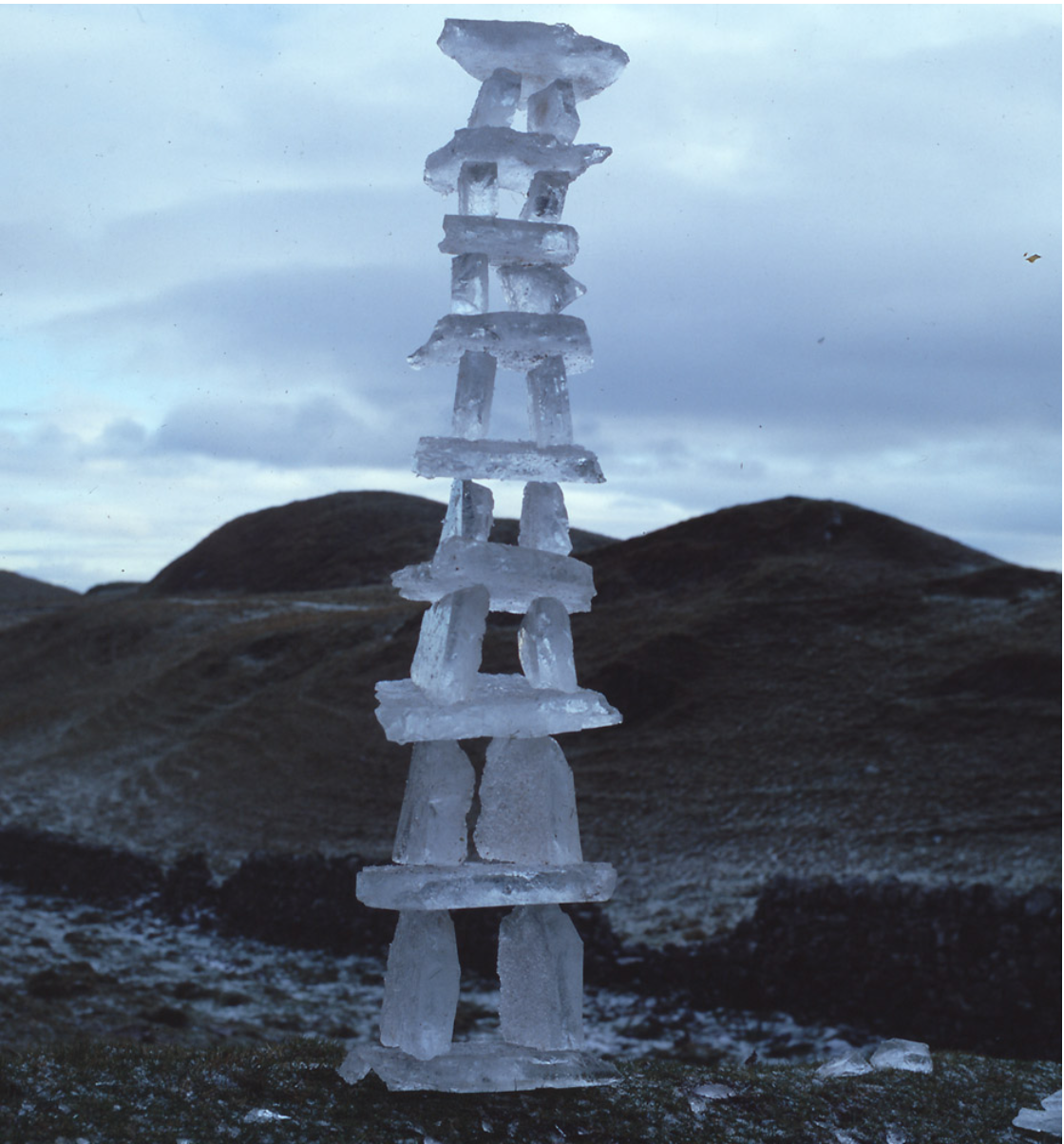
If we consider, for example, the ice sculpture shown below. It consists of eight storeys each resembling the columns and entablature of a greek temple or if you prefer the sarsens at stone henge.


Just like the designers of those ancient structures, Goldsworthy has realised that tension is the enemy he must subdue. By placing the ice columns close together he prevents the lintels from developing excess tension on their soffits. For a similar reason the columns have been carefully aligned so that load can travel from top to bottom in direct bearing.

Further examples of matching form to material are shown in the sculptures below. One shows an arch constructed from thin wedges of ice and the other from stone and snow. Both resemble the classical form of a traditional masonry arch. 


It is of course well known that arches are compression structures and are therefore inherently suited to materials that dislike tension. With an ample supply of stone, and a primitive form of concrete, it is unsurprising that Roman architecture features arches so prominently.

That said, it is Goldsworthy’s decision to construct his arches in the traditional way using wedges that is interesting, particularly the one made of ice. This choice allows us to get a deeper sense of how arches work.

After finding ourselves unintentionally seated on the ground, everyone has undoubtably discovered that ice is slippery. Knowing this to be true why don’t the pictured ice wedges at the crown of the arch simply slip past each other, under the action of their own self-weight, thus causing the arch to collapse? This is not a trivial question.

In 1695 the Frenchman Philippe de la Hire was the first to compose a theory of masonry arches using mathematics. He began by assuming that the wedge shaped stones (voussoirs) from which arches were formed have infinitely slippery surfaces i.e. the joints between them are frictionless. He then set about tackling the question, how heavy [and by inference how thick] should the voussoirs be to keep an arch stable?

In this most slippery of scenarios it is, by definition, impossible for forces to develop parallel to the joints between voussoirs. The weight of the arch must therefore thrust exactly perpendicular to the joints.

It can be seen from the photos above that the wedges of ice [and thus the joints between them] are vertically aligned at the crown of the arch and therefore at this point the weight of the arch must act horizontally i.e. perpendicular to the joints.

Moving away from the centre of the arch the inclination of the ice becomes steadily flatter. Since, the weight of the arch must still act perpendicular to the joints it is bent around the curve of the arch. 

This is where the problem starts to get interesting. If the arch is built on a flat base, as shown in the image above, La Hire discovered that the weight acting at its base must be infinite or the arch will be unstable, which is obviously wrong.

La Hire rightly concluded that friction must therefore be present between the voussoirs [even if they are made of ice] though it was left for others to account for it in subsequent theories. It is this frictional force that stops the wedges of ice slipping from the arch’s crown.

In some ways it would be satisfactory to end here, but we are not quite ready to finish. There is something else that turns out to be important, which we have not yet discussed. Thus far we have been taking about wedges or voussoirs and the analogy holds reasonably well in the instance of the Goldsworthy’s snow arch.

In the case of his ice arch the analogy is a little imperfect, because the shards of ice are in fact flat and not really wedge shaped al all. We would normally think of a wedge as having a fat and a thin end.

This doesn’t at all undermine what we have said thus far; all of that still holds. What is interesting is that without a fat and thin end the shards of ice are in contact on the inside of the arch, but gaps necessarily open up at the outside edge. The thicker the arch the more pronounced would be the gaps.

The significance of this is the contact area between the shards of ice is only a fraction of their surface areas. Since the ice does not fracture we may infer that the stress in the arch must be quite low and would certainly be in no danger of crushing its component parts. 

This principle was demonstrated in 1846 by Barlow at the Institution of Civil Engineers in London. He built a model arch with six voussoirs using slender prices of wood en lieu of mortar. In progressively withdrew the slips of wood in three locations to show the stability of arch would be maintained.

Taken together the thoughts we have outlined illustrate the key principles of masonry arch design. Namely, friction must be present between the stones; the strength of the stone is of little importance; and finally the stability of an arch relies entirely on its geometry and weight. Since weight is a function of geometry and friction is a function of weight we might just as easily say the stability of an arch is a function of its geometry.

I have no idea whether or not Andy Goldsworthy’s thinking has extended this far, nevertheless the question was worth addressing, because the answer surely enhances our appreciation of his art.

Now I realise in reaching this point that some may be thinking that I have, in discussing geometry and forces, undermined the original premise of this post. You might say that I have turned art into science.

I beg to differ. 

Isn’t the point of modern art it’s subjectivity? Isn’t it supposed to make us think individually about what it represents and then decide how that makes each of us feel? Well, in my subjective view this is what I think it represents. It satisfies my curiosity and that makes me feel happy.


On Ice Shelf Cracking

Tension Cracks in the Brunt Ice Shelf Yesterday the BBC news website published images showing a large section of the Brunt ice shelf in Ant...